Suffix (Basic ㊦ 381)
A suffix that makes a noun out of an adjective by attaching it to the stem of an Adj (い) or much less frequently to the stem of an Adj (な)
Equivalent: -ness; -ly
| Adjective (い/な) stem | さ | |
| 高さ | Height | |
| 静かさ | quietness |
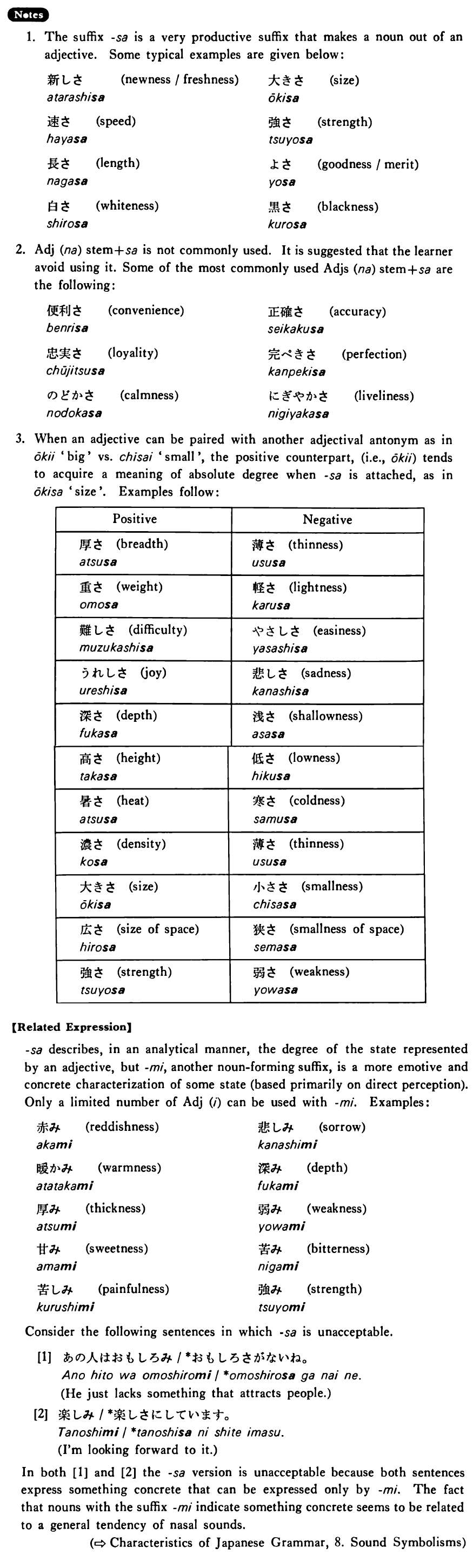
1. The suffix さ is a very productive suffix that makes a noun out of an adjective. Some typical examples are given below:
2. Adjective な stem+さ is not commonly used. It is suggested that the learner avoid using it. Some of the most commonly used Adjective な stem+さ are the following:
3. When an adjective can be paired with another adjectival antonym as in 大きい 'big' vs. 小さい 'small', the positive counterparty (i.e., 大きい) tends to acquire a meaning of absolute degree when さ is attached, as in 大きさ 'size'. Examples follow:
| Positive | Negative | ||
| 厚さ | breadth | 薄さ | thinness |
| 重さ | weight | 軽さ | lightness |
| 難しさ | difficulty | やさしさ | easiness |
| うれしさ | joy | 悲しさ | sadness |
| 深さ | depth | 浅さ | shallowness |
| 高さ | height | 低さ | lowness |
| 暑さ | heat | 寒さ | coldness |
| 濃さ | density | 薄さ | thinness |
| 大きさ | size | 小ささ | smallness |
| 広さ | size of space | 狭さ | smallness of space |
| 強さ | strength | 弱さ | weakness |
【Related Expression】
さ describes, in an analytical manner, the degree of the state represented by an adjective, but み, another noun-forming suffix, is a more emotive and concrete characterization of some state (based primarily on direct perception). Only a limited number of Adjective い can be used with み. Examples:
Consider the following sentences in which さ is unacceptable.
[1]
[2]
In both [1] and [2] the さ version is unacceptable because both sentences express something concrete that can be expressed only by み. The fact that nouns with the suffix み indicate something concrete seems to be related to a general tendency of nasal sounds.